
What are the differences between ISO 9001 and ISO/IEC 17025? Which standard should businesses choose?
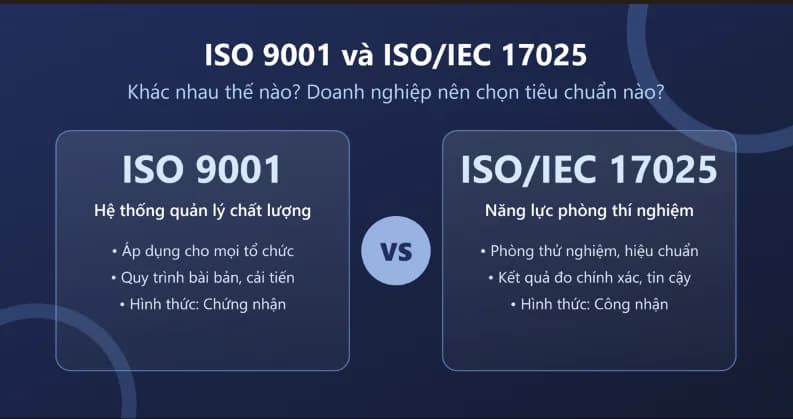
ISO 9001 helps companies manage quality systematically. ISO/IEC 17025 demonstrates that testing and calibration laboratories have the technical competence and reliable measurement results. This article compares the two standards in terms of their subject matter, focus, certification format, and value proposition, helping businesses choose the right standard for their needs.
When learning about quality, many businesses often confuse ISO 9001 and ISO/IEC 17025. Both are international standards and both address "quality." However, their purposes, target audiences, and the value they deliver are vastly different.
What is ISO 9001?
ISO 9001 (current version: ISO 9001:2015) is a standard for quality management systems . It can be applied to any organization, regardless of industry or size: factories, service companies, hospitals, schools, etc.
ISO 9001 focuses on:
Understand customer needs and satisfy them.
Manage tasks using clear and consistent procedures.
Identify risks and opportunities.
Continuous improvement.
In short, ISO 9001 answers the question: "Does the company operate in a systematic, stable, and continuously improving manner?"
What is ISO/IEC 17025?
ISO/IEC 17025 (current version: ISO/IEC 17025:2017) is a standard specifically for testing and calibration laboratories . Examples include sample testing laboratories, instrument calibration units, and QC departments in factories.
This standard requires the laboratory to demonstrate:
The personnel are qualified and their skills have been assessed.
The equipment is properly calibrated and maintained.
The measurement results can be traced back to national/international standards (measurement traceability).
The testing method has been verified to yield accurate results.
Calculate the measurement uncertainty , which is the possible margin of error for the result.
Participate in proficiency testing , which means comparing results with other laboratories.
Operating objectively , without being influenced by vested interests.
In short, ISO/IEC 17025 answers the question: "Are these measurement and test results reliable?"
Quick comparison table
ISO 9001/ISO/IEC 17025 Criteria Target: All types of organizations Testing laboratories, calibration laboratories Focus: Quality management system Technical competence and reliability of results Scope: Entire organization or individual departments Specific tests, calibrations Form : Certification (issued by a certification body) Accreditation (issued by an accreditation body, in Vietnam it is BoA – VILAS program) Key Questions: “Is the process good and stable?” “Are the results accurate and reliable?” Technical Requirements: General, not in-depth measurement Very detailed: calibration, measurement uncertainty, method verification Value to customers: Demonstrates the company's professionalism Results are widely accepted, including internationally (through ILAC agreements)
The most important difference
Having ISO 9001 certification does not necessarily mean the laboratory is technically competent.
A laboratory might have clean procedures and complete documentation according to ISO 9001. But ISO 9001 doesn't check whether the measuring equipment is accurate, whether the technicians are performing the measurements correctly, or how much error there is in the results. That's the job of ISO/IEC 17025.
Conversely, ISO/IEC 17025 already includes management aspects similar to ISO 9001, so a laboratory that meets 17025 standards is also operating according to quality management principles.
Which standard should businesses choose?
Choose ISO 9001 if you want to improve the quality of management for your entire company, meet bidding requirements, or if your clients require ISO certification.
Choose ISO/IEC 17025 if you have a testing or calibration laboratory and want your results to be recognized by customers, government agencies, and international partners.
Apply both if you are a manufacturer with your own QC or measurement department. ISO 9001 for the entire company, ISO/IEC 17025 for the laboratory.
When choosing a calibration and testing unit, ask about ISO/IEC 17025.
If you're outsourcing equipment calibration or sample testing services, don't just ask "do you have ISO?". Ask:
Is the organization ISO/IEC 17025 accredited?
Is the measurement you need within an accredited range?
Does the calibration certificate indicate the measurement uncertainty and the accreditation mark?
These three questions help you ensure that the results you receive are reliable and acceptable during evaluation and testing.
Frequently Asked Questions
Which is "higher": ISO 9001 or ISO/IEC 17025?
Neither is superior to the other. The two standards serve two different purposes. For laboratory use, ISO/IEC 17025 is more suitable and valuable.
Does a laboratory that has achieved ISO/IEC 17025 certification need to also have ISO 9001 certification?
It's not mandatory. However, if the entire company has implemented ISO 9001, the laboratory can share that management system.
How long is the certificate valid for?
Typically, the accreditation period is 3 years for ISO 9001, with annual surveillance audits. For ISO/IEC 17025, the duration and audit schedule are determined by the accreditation body (in Vietnam, it's usually 5 years, with periodic surveillance audits).
Do you need equipment calibration or consultation regarding ISO 9001 / ISO/IEC 17025?
Contact Micro Precision Calibration Vietnam for a free consultation: 02837696879 · vn-contact@microprecision.com · https://microprecision.vn/